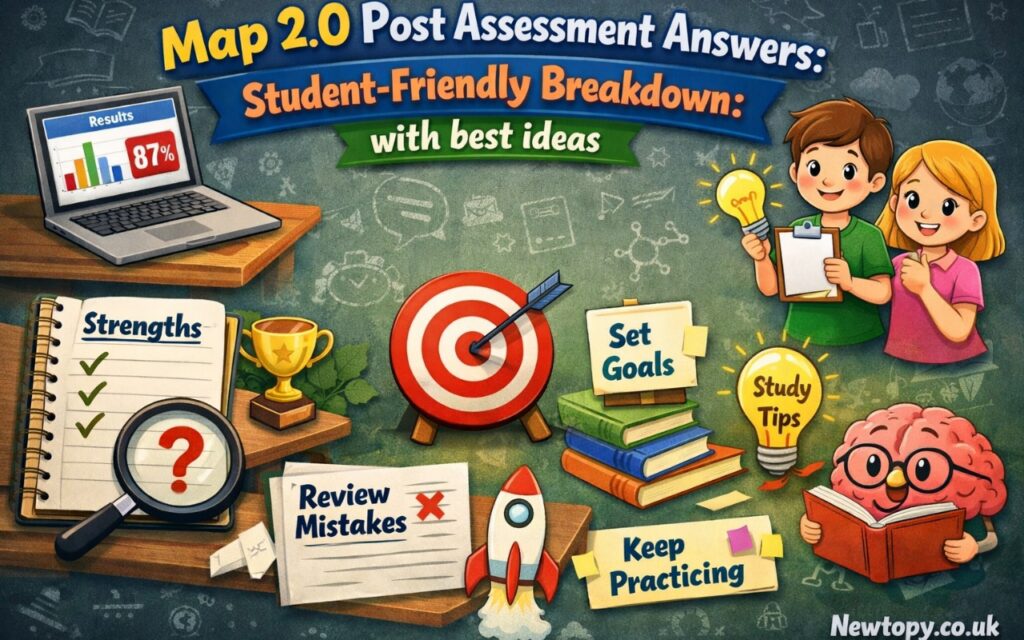

The Map 2.0 post assessment answers topic has become increasingly popular among students, teachers, and parents who want a clearer understanding of how MAP 2.0 assessments work and how to interpret results effectively. MAP 2.0, often associated with digital learning platforms and adaptive assessments, is designed to measure a student’s understanding after completing a learning module. The post-assessment phase is especially important because it reflects what a learner has truly absorbed, identifies knowledge gaps, and helps educators plan next steps.
This article offers a human-written, student-friendly, and informative breakdown of Map 2.0 post assessment answers. Instead of simply listing answers, we’ll explain concepts, strategies, common question types, and how students can use their results to improve future performance. Whether you’re preparing for an assessment, reviewing results, or helping someone else understand the system, this guide is designed to be practical, ethical, and educational.
Understanding Map 2.0 and Its Post Assessment Structure
To fully grasp map 2.0 post assessment answers, it’s important to first understand what Map 2.0 actually is. Map 2.0 is typically an adaptive learning and assessment framework used in schools or digital education systems. It evaluates student progress based on learning objectives rather than rote memorization. Unlike traditional tests that offer the same questions to every student, Map 2.0 adjusts question difficulty based on responses, providing a more accurate picture of individual understanding.
The post assessment is conducted after a learning module or unit has been completed. Its main purpose is to measure mastery of skills and concepts introduced during instruction. Questions often focus on application, reasoning, and problem-solving rather than simple recall. Because of this, post assessment answers are not just about right or wrong choices—they represent how well a student understands the “why” behind a concept. This makes Map 2.0 particularly useful for long-term learning rather than short-term exam preparation.
Why Map 2.0 Post Assessment Answers Matter for Students
Many students search for map 2.0 post assessment answers because they want reassurance about their performance or clarity about where they went wrong. These answers matter because they act as a learning mirror. Instead of seeing assessments as judgment tools, Map 2.0 encourages students to view results as feedback that supports growth.
Post assessment answers help students identify strengths and weaknesses. For example, a student may perform well in multiple-choice questions but struggle with open-ended reasoning. By reviewing answers carefully, learners can understand which skills need improvement. Teachers also rely on these answers to adapt instruction, group students appropriately, and offer targeted support. In this way, Map 2.0 answers benefit both learners and educators, making the learning process more personalized and effective.
Common Question Types in Map 2.0 Post Assessments
One reason students feel confused about map 2.0 post assessment answers is the variety of question formats. Unlike traditional exams, Map 2.0 assessments may include multiple-choice questions, short answers, drag-and-drop activities, matching tasks, and scenario-based problems. Each format tests understanding in a different way.
Multiple-choice questions often assess concept recognition, while short-answer questions evaluate explanation skills. Scenario-based questions, which are common in Map 2.0, require students to apply knowledge to real-world situations. These questions may not have obvious answers, pushing students to think critically. Understanding the intent behind each question type helps students approach assessments more confidently and interpret their answers more effectively.
How to Approach Map 2.0 Post Assessment Answers Ethically
It’s important to clarify that searching for map 2.0 post assessment answers should not mean copying or cheating. Ethical learning is at the core of Map 2.0’s philosophy. Instead of memorizing answers, students should focus on understanding concepts and learning from mistakes.
A healthy approach is to review answers after completing the assessment. Look at incorrect responses and analyze why they were wrong. Ask questions such as: Did I misunderstand the concept? Was I rushing? Did I misread the question? This reflective practice helps reinforce learning. Teachers and parents can support students by discussing answers together, focusing on explanations rather than scores. Ethical use of post assessment answers builds long-term academic confidence and integrity.
Step-by-Step Guide to Reviewing Your Map 2.0 Results
Reviewing results is where map 2.0 post assessment answers become most valuable. Start by examining your overall performance and identifying patterns. Are there specific topics where mistakes are frequent? Are errors related to comprehension, calculation, or interpretation?
Next, review individual questions. Read both the question and the correct answer explanation, if provided. Compare it with your response to identify gaps in understanding. Take notes on recurring mistakes and revisit learning materials related to those topics. This step-by-step review process transforms assessment answers into actionable learning tools rather than static results.
How Teachers Use Map 2.0 Post Assessment Answers
From an educator’s perspective, map 2.0 post assessment answers provide insight into classroom effectiveness. Teachers analyze results to see which concepts were well understood and which require reinforcement. If many students struggle with the same question, it may indicate that the topic needs to be taught differently.
Teachers also use answers to differentiate instruction. High-performing students may receive enrichment activities, while others receive targeted practice. This data-driven approach makes learning more inclusive and efficient. By understanding how teachers use post assessment answers, students can better appreciate the role of assessments in shaping instruction rather than simply grading performance.
Common Mistakes Students Make When Interpreting Answers
One common mistake students make when reviewing map 2.0 post assessment answers is focusing only on the score. While scores matter, they don’t tell the whole story. A low score doesn’t mean failure, and a high score doesn’t guarantee full understanding.
Another mistake is ignoring explanations. Some students quickly glance at correct answers without reading why they are correct. This limits learning potential. Others may blame external factors like time pressure without reflecting on preparation strategies. Avoiding these mistakes requires a growth mindset—viewing answers as learning opportunities rather than judgments.
Tips to Improve Future Map 2.0 Post Assessment Performance
Improving performance starts with understanding map 2.0 post assessment answers and applying lessons learned. One effective tip is active revision. Instead of rereading notes passively, engage with the material by summarizing concepts in your own words, creating mind maps, or teaching someone else.
Practice problem-solving regularly, especially with scenario-based questions. Time management is another key factor—practice answering questions under timed conditions to build confidence. Finally, ask for feedback from teachers. Discussing assessment answers openly can clarify misunderstandings and strengthen learning strategies for future assessments.
Role of Parents in Supporting Map 2.0 Learning
Parents often search for map 2.0 post assessment answers to help their children succeed. Their role is crucial in creating a supportive learning environment. Instead of pressuring children for perfect scores, parents should focus on understanding assessment feedback and encouraging improvement.
Parents can help by reviewing answers together, asking open-ended questions, and celebrating progress. Providing a quiet study space and maintaining a positive attitude toward assessments can significantly impact a child’s confidence. When parents understand the purpose of Map 2.0 assessments, they can become partners in the learning process rather than sources of stress.
Final Thoughts on Map 2.0 Post Assessment Answers
The topic of map 2.0 post assessment answers goes far beyond simply finding correct responses. It’s about understanding learning progress, identifying strengths and weaknesses, and using feedback to grow academically. Map 2.0 assessments are designed to support personalized learning, and post assessment answers play a central role in that mission.
By approaching these answers ethically and thoughtfully, students can transform assessments into powerful learning tools. Teachers and parents also benefit from understanding how answers reflect learning patterns and guide instruction. Ultimately, Map 2.0 post assessment answers are not endpoints—they are starting points for continuous improvement and academic success.